



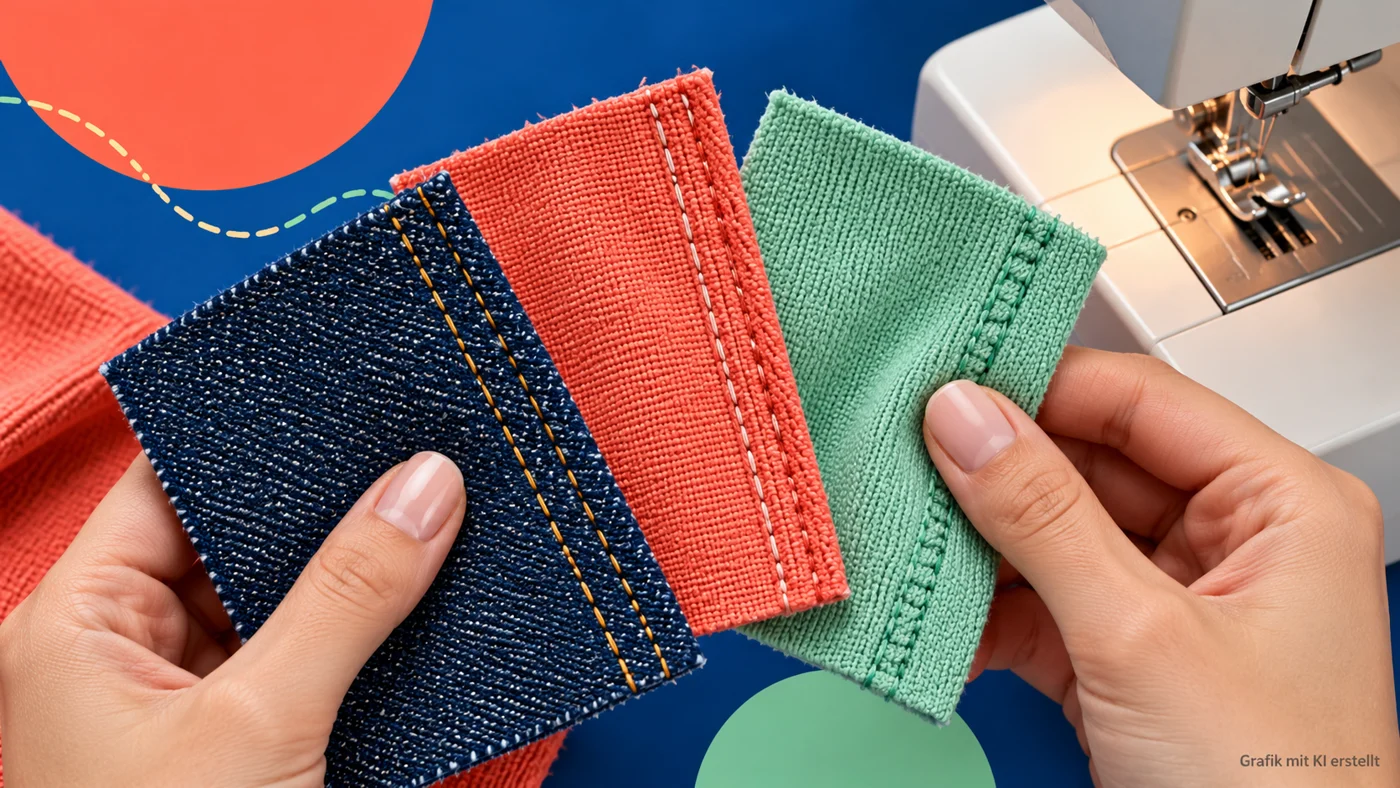
Would you like to sew a denim bag, a light blouse, or a soft pillow? With the right needle, fabric, thread, and your idea come together. That’s why the selection process starts with your project. The pictures show you different materials—then we’ll help you choose the right system, lace, and thickness.

Would you like a quick overview?
AI summary
Key points at a glance
System Before Strength
The machine instructions determine the needle system; the needle size alone is not enough.Select Type by Fabric
Universal, jersey, stretch, denim, and Microtex serve different purposes.Understanding Package Labels
NM refers to the thickness; 80/12 are two designations for the same thickness.Test stitch and fresh needle
Test the combination on the original fabric and replace any damaged needles immediately.When choosing sewing machine needles, first check your machine’s system, then select the needle type that’s right for your fabric, and finally choose the gauge that matches your fabric and thread. The universal needle is a versatile starting point, but it’s not the right choice for every material. Especially when working with knits, fine, dense fabrics, or leather, it’s worth selecting the right needle for the job.
Here at MAKEMA, we carry needles and sewing machine accessories. These instructions will help you better organize your needle pack and choose exactly what you need for your next project. You don’t have to buy every type of needle in advance.
The needle system must first be compatible with the machine
The system describes the needle type that is compatible with the machine. On many household sewing machines, you’ll see 130/705 H. Be sure to read the instructions for your specific model anyway: The correct needle size cannot compensate for an incorrect needle type. Especially with overlock and cover machines, you shouldn’t simply assume that the household needle system applies.
The system designations are followed by suffixes indicating the needle type. For example, SCHMETZ specifies 130/705 H-S for stretch fabric and 130/705 H-M for Microtex. Make a note of the complete specification before selecting a product. If you’re unsure, our Machine Passport when assigning machines and accessories; the specific instructions remain the basis.
How to Read the Needle Package
| Specification | What it means | What you conclude from this |
|---|---|---|
| System, e.g., 130/705 H | Needle Design | Check against the machine manual |
| Type, e.g., stretch or Microtex | Geometry for Specific Applications | Choose based on material and intended use |
| Strength, e.g., 80/12 | NM 80 and SIZE 12 refer to the same thickness | Do not confuse this with two needles or a range of sizes |
| Mix of starches, e.g., 70–90 | The package contains several strengths | Choose the right needle for your project |
The metric designation NM corresponds to one hundred times the needle shank diameter. NM 80 therefore means 0.80 mm. The second number in “80/12” comes from the SIZE system. It describes the thickness, but does not indicate whether the needle is intended for jersey, denim, or a fine fabric.
Which needle is best for which fabric?
The following guidelines apply to the SCHMETZ needle types described. Other manufacturers may offer different geometries and product lines. Therefore, even if you recognize the part number, be sure to verify the specific product.
| Needle Type | Typical Applications | Key Limitation |
|---|---|---|
| Universal | Many woven fabrics and everyday sewing projects | Make more specific selections for special materials or missed stitches |
| Jersey | Knitted and woven fabrics, such as many types of jersey and sweatshirt fabrics | For particularly stretchy fabrics, also check the “Stretch” option |
| Stretch | Stretch or highly stretch knit fabric | The special geometry is not the same as that of a Jersey needle |
| Jeans | Heavyweight fabrics such as denim, twill, or canvas | The needle type does not replace the machine’s layer and capacity limits |
| Microtex | Fine, tightly woven, or suitably coated materials | Check the slim tip regularly for damage |
| Leather | Suitable leatherwork with a cutting tip designed for this purpose | Do not use this product on all textiles or all types of faux leather |
Jersey or Stretch: Why the Difference Matters
Jersey refers to a type of knitted fabric, but not all knitted fabrics have the same elasticity. SCHMETZ jersey needles feature a medium-round tip. The stretch needle also has a special geometry in the area of the groove and eye, as well as a more pronounced flattening of the shank. This is designed to optimize stitch formation in elastic materials.
If you get skipped stitches on a highly elastic fabric, using a thicker jersey needle isn’t always the solution. Check for the right type of stretch needle in the appropriate size and adjust the other settings. A thin, highly elastic fabric doesn’t need the thickest possible needle just because it’s difficult to sew.
For your T-shirt or sweatshirt project: Select SCHMETZ Jersey for suitable knitwear or SCHMETZ Stretch, Thickness 75 for suitable, more elastic fabrics. Compare the 130/705 H system and the corresponding model with your machine’s manual; a test stitch will determine the specific combination.
Jeans needles aren’t necessarily particularly sharp
The SCHMETZ jeans needle has a medium-sized ball point and a special shaft design for sturdy materials. Microtex, on the other hand, has a slim, pointed tip. The rule of thumb “jeans = sharpest needle” is therefore misleading. Base your decision on the manufacturer and the material, not on this generalization.
For denim and canvas projects, you can find SCHMETZ jeans needles 130/705 H-J at MAKEMA. Choose the appropriate needle size based on the thread and number of layers; the needle system must be compatible with your machine.
Faux leather requires a close look
Faux leather may have a fabric backing. A sharp leather needle can damage it. For soft faux leather, SCHMETZ recommends trying a Microtex needle first in combination with its DH leather needle. Test it on a scrap piece; permanent needle holes cannot be easily closed.

What’s the right needle size?
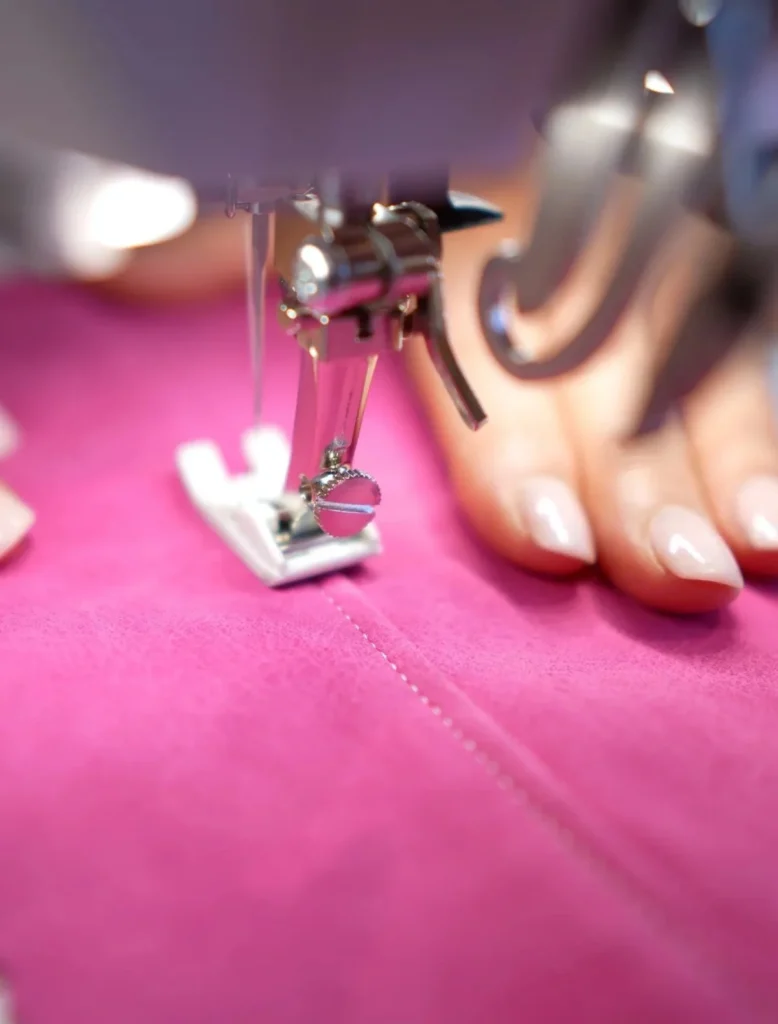
Choose a needle size that matches the material, layers, and thread. A needle that is too fine may not work well with a thick thread; a needle that is unnecessarily thick may leave visible stitches. Therefore, the largest possible needle size is not automatically the strongest or most attractive solution for your project.
A practical starting point: Check the fabric-thread-needle chart in your machine’s manual and the needle manufacturer’s specifications. Then test the same combination of fabric layers that will be used in your project. A test on a single layer of fabric won’t tell you how a multi-layer seam will hold up.
A small selection of needle sizes can be useful for different types of woven fabrics. The Husqvarna VIKING universal needles in our lineup include sizes 70, 80, and 90. Choose the right one for your project and check which system is compatible; when sewing jersey, the choice of needle type is up to you.

Microtex as a Targeted Supplement
If your project involves fine, tightly woven, or appropriately coated materials, Microtex may be a good choice. The SCHMETZ product linked here features the 130/705 H-M system. On the product page, select the appropriate available weight and test it with your yarn and fabric.
You can find more types in the MAKEMA needle assortment. Put together your own assortment based on the fabrics you use: You may need different types for woven fabrics, stretchy clothing, and bags; you don’t need a complete collection for a single project.

Insert the needle, sew a test stitch, and narrow down the problem
- Back up the machine: Turn it off when changing the needle, and follow the safety instructions in the manual.
- Inserting the needle: Make sure it is facing the correct direction and is securely fastened. Attach it as described in the instructions.
- Re-thread and check: Use an appropriate needle-thread combination. Check the thread path.
- Testing the original material: Sew on a scrap piece of fabric with the same weave and the same yarn.
- View the seam: Check for missed stitches, thread damage, and entry points. Change one factor at a time so that the next test is meaningful.
If the needle is bent, damaged, or shows signs of wear after a bump, replace it immediately. SCHMETZ suggests about eight hours of sewing time as a rule of thumb for regular replacement, or the start of a new project as an easy-to-remember alternative. This is not a guarantee of a specific service life: the material and the amount of use also play a role.
| Observation | Initial Targeted Review |
|---|---|
| Missed stitches | Fresh, properly inserted needle; type for elasticity; threading |
| Frayed thread or broken thread | Needle condition, appropriate eye size or gauge, and thread path |
| Noticeable holes or damaged stitches | Check the needle type and size on the original material |
| The needle gets stuck or breaks | Stop immediately; check that the installation is correct and that the combination is permitted according to the instructions |
Frequently Asked Questions About Sewing Machine Needles
Can I use the same needles for my sewing machine and serger?
Only if the specific instructions indicate that the machine is compatible. Overlock and cover machines may require different systems, such as variants of the ELx705. Therefore, order based on the specific machine and not on the assumption that all household machines use the same needle.
Is a universal needle also an embroidery needle?
The term “Universal” does not mean it’s suitable for every embroidery project. When embroidering, check the machine’s specifications as well as the thread and fabric. If you’re just getting started on your first embroidery project, the upper and lower threads are just as important as the needle.
For machine embroidery, MAKEMA offers Madeira Universal Embroidery Needles, Size 75, System 130/705 H-E in a pack of 5. They are designed for machine embroidery threads made of viscose, polyester, or cotton. Check the required system and the thickness of your embroidery machine, as well as whether they are suitable for your fabric.
If I run into problems, can I just use a thicker needle?
First, check the type, condition, and installation. Increasing the thickness won’t fix an incorrect needle type or a faulty thread path. Also, keep an eye on the permissible thread thicknesses for your machine.
Sources and Timeliness
Product details and linked MAKEMA product range verified on October 10, 2026. Current prices, variants, and availability can be found on the product pages. The model examples are an editorial selection and do not represent our own hands-on testing.


I actually didn’t know that 80/12 were two different ways of specifying the same thickness. The explanation on the package was very helpful.
Up until now, I thought jersey and stretch were the same thing 🙈 Thanks—now the difference is clearer.
The chart is really helpful. When it comes to bags, I’ve mainly been paying attention to the thickness so far. Can I use my household needles for the serger, or do I need a different kind?
Hi Ute, that depends on the exact model and the recommended needle system. Check the overlock manual; some overlock and cover machines require a different system. The type and size alone aren’t enough to determine the right fit. If you provide us with the full model number and the needle specifications from the manual, we can help you narrow down the options. Best regards, Mark
The table is nice and clear. Before I start my next bag project, I’ll check the system and type first, rather than just the thickness listed on the package.